Showing posts with label anual event. Show all posts

Friday, September 30, 2022

The fascinating enigma of red spider lilies


Red spider lilies, in Japanese, “Higan-bana” (flowers which bloom on and around the Autumnal Equinox) have a very peculiar reputation among the older generation in Japan. My grandma, my mother and my mother-in-law all used to say that you can't grow red spider lilies in your home garden.
The reason being that these flowers were likely to bring unwelcome happenings in families- at least this was what they'd been taught. The flowers were often linked to blood and even fire because of their vivid red color. So where does all this come from?

Somehow spider lilies were considered ominous despite their beauty. This was due to a commonly believed association with “death” stemming from a story way back when people buried bodies in the ground after a funeral. To prevent animals unearthing the ground in graveyards, people planted spider lilies in and around graves. The flowers have poison in their bulbs, petals, stems and leaves and grow in clusters. Thus they kept our ancestors’ bodies from being damaged by animals.
Now due to changes in our lifestyle, we don’t use the flowers for this purpose anymore. Nowadays farmers plant spider lilies simply to protect their products from mice, moles, and insects.


Red spider lilies are now, generally speaking, free from this malicious image. However there are still some people who choose to hang on to fears and superstitions and for them red spider lilies are no exception. Ironically Buddhism has a totally opposite view of the flower and regards it as a sign of grace . In Japanese there are more than 1,000 different names for spider lilies, one is “Manjushage”. Sounds exotic, doesn’t it? It comes from Hindi and means - a heavenly flower which doesn't grow on earth but only in heaven!

Nowadays people enjoy watching these flowers bloom in clusters in parks, gardens, rice fields, and riverbanks. They are delightful to look at and weirdly become even more attractive when we hear about the creepy stories surrounding them!
They are just BEAUTIFUL flowers!


Friday, August 14, 2020

Does COVIT-19 change our culture?


 We are in the midst of the Obon holidays in Japan. 

Obon is a series of Buddhist memorial services for family ancestors which generally takes place on August 14 and on 15. To put it more precisely, when the event takes place depends on the sect you belong to or the local area you live in. My family belongs to the Soto sect and the services of Obon actually start earlier in August.

Every year, this is the time when many Japanese visit family graves in temples together along with family members who usually live apart such as children with families of their own. It’s a big family reunion.

However, this year, due to the coronavirus pandemic, things are quite different.

In order to avoid close contact, our temple has decided to minimize Obon memorial services. They have also limited the number of visitors from one family. The other day, at the beginning of the Obon, two people from one family were allowed to attend the service with a mask on in accordance with the service time schedule. The temple main hall used to be full of families coming in and out the whole day, exchanging greetings with one another—but not this year. There was no opportunity for us to talk with the principle monk and his family in person, and no tea service to relax with after the prayers either. We just gave a simple bow in greeting and farewell from a distance.

On August 15th, the last day of the Obon, the memorial service for our ancestors won't be an exception. This time, four members from one family will be allowed to participate in the memorial service in the main hall.
Surprisingly enough, many other temples have also suspended the Obon memorial services in their halls and have decided to provide memorial services via the Zoom meeting instead. We had never expected that IT technology would prevail in our traditional practices at temples and at home.

I know the temples took a drastic measure to prevent us from infection. Yet, it's sad that we are forced to change our tradition. No one can tell what Obon will look like next year.

No matter what, it’s time for us to remember our ancestors, including our parents who left us not so long ago, and to pray to them for protection at our family altar.


Thursday, February 08, 2018

Retired Hina Dolls

For the last few years, you may have seen some small hina dolls in unexpected places or in unusual postures.

At the Chubu International Airport, I saw hina dolls sitting casually along a sidewalk into a building. They didn't sit neatly on a tiered stage, just like you would expect with a regular set of hina dolls on display. 

Rather, they were placed in many spaces and on corners, and they were in some vivid, realistic poses. Some are reading newspapers or books, and some talking over a cup of coffee together; some hoist a flag of welcome to tourists, and some look happy with shopping bags in their arms.

They are happily "retired hina dolls".

When their outfits got worn out over the years and were not suitable to be displayed at home, people handed them down to various public communities in towns and cities across the country. People arranged those dolls to entertain visitors, so as to energize communities during the hina doll festive season.

So they are called “fuku-yose-bina” in Japanese, which literally means “good luck inviting hina dolls.”


Saturday, February 27, 2016

Radio Exercises in Tsuruma Park


Tsuruma Park in Nagoya was the first public park in the region. It was established in 1909.
The existing modern and classic buildings and monuments tell us many stories related to the origin of this park and life in Nagoya in the early 1900s.

The boy statue in front of us is one example.
He is frozen in the middle of doing calisthenics, called “rajio taiso”, which literally means “radio exercises”.


“Rajio taiso” has a long history of 88 years, from the first broadcast of exercise routines over the radio by the Japan Postal Insurance Bureau.
“Rajio taiso” is a kind of rhythmic exercise to music on the radio. The program starts at 6:30 in the morning every day and goes for 15 minutes.


The insurance bureau started this project so that people would be more conscious of maintaining good health since the Japanese life expectancy was quite low at that time. Strictly speaking the idea for radio broadcast calisthenics came from the US.  The exercise consists of 13 different but easy movements to stimulate almost all of your muscles -- even the inactive ones -- to get your blood circulating.

 
It was included as a regular group routine at elementary and junior high schools.
Later, in the 1950s, it was aired on TV as well as on the radio several times a day; it became very popular among adults at offices, factories and also at many other workplaces.
Currently, it is reported that 20% of the entire population, or around 27 million people, and 76% of elementary schools, still do radio exercises.

Regardless of age, almost all Japanese people can perform the 13 movements if they hear the music or sometimes simply by humming it. Here in Tsuruma Park, somewhere between 100 and over 350 people, usually seniors, gather around the Sougakudo bandstand for “rajio taiso” every morning throughout the year.Tsuruma Park is the perfect place for a “rajio taiso” gathering, and it has been this way for 50 years.

If you would like to join in doing “rajio taiso”, you don’t need to apply.
All you have to do is to get up early.

Wednesday, December 17, 2014

Time to replace Japanese paper "washi"

Just a few days ago  I was wondering all day that day whether or not I should have replaced the washi paper on our front doors.

The front doors are sliding doors of lattice frames applied with Japanese paper.  I like a type of our traditional house but as the front doors, how I wished if they would have not been too classic. I make it a rule to replace paper  every year since white color looks quite faded out by the end of the year. Or it simply gets damaged or gets holes by then.

The weather really counts for this annual chore because I have to take off the front doors and to apply washi papers in an open air.  I don't want to do it on a chilly day.

You might wonder why I do this at this time of the season in cold weather.  It's because we celebrate the arrival of the new year  in a clean house, clean rooms and clean kitchen. We also  change old items into new ones, such as some underwear, towels, family chopsticks and even toothbrushes.  We are busy finishing all these  in time for the new year.

Applying new paper is not an exception.   I wait to replace paper on our front doors until it gets close enough to the last day of the year.

Yesterday  it was not so windy and not that cold.  I should not have waited for another chance.
So I got started just as some images below.

And finally I completed it. So happy and contented with the result.


One of the things I like about  Japanese paper "washi" on siding doors is that it gives the warm and soft sunlight filtered through  paper. The charm of  sliding doors applied with Japanese paper is outstanding when we sit and see the light coming across the screens indoors rather than outdoors.


Monday, March 03, 2014

Today March 3rd 2014


Today it's Dolls Day Festival !

These chicks dressed like a pair of "Hina" dolls are puddings
from a popular confectionery right in the Nagoya station building. 
Enjoy the Hina Dolls Festival with your families and friends !


Sunday, February 16, 2014

Checking the requested route on foot


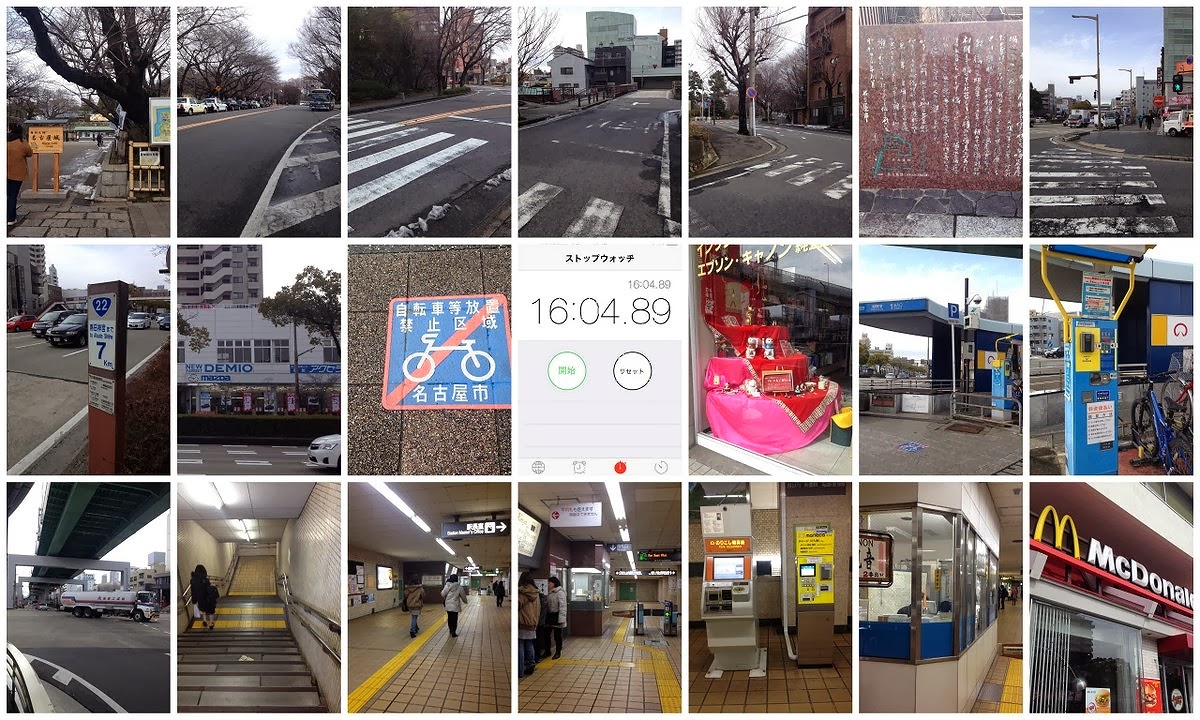
Ahead of the tour for a group of 40 businessmen from India on February 24th, I walked the new route to another subway station from the front gate Nagoya Castle to find out how long it will take me to complete it.  We have to make the itinerary for that tour.

I set my iPhone stopwatch and started walking the new route. It took approximately 16 minutes to get to the subway ticket gate downstairs. Also I found some interesting spots on the way which the guests might get interested in.

A lot of preparation are necessary.


Friday, February 14, 2014

Happy Valetine's day from snow-covered Japan


It's snow again. This time it has been snowing at a wide area in Japan through the Pacific coast of eastern to the western Japan.  In Tokyo it's snowing much heavier than here in Nagoya.
The thing is that once it snows in big cities where snow rarely falls, the transportation gets paralyzed and people have to be patient for the inconvenience.


Staying home is the best choice on such a day------but not quite true for me.  I have to clear snow from the walkway before it gets dark in the evening. 
What a nice way to celebrate a Valentine's Day!

"Happy Valentine's day to everyone.
Greetings from snow-covered Nagoya, Japan!"


Sunday, November 17, 2013

Magic of Light and Shade

This year again, I went to see my old friends from university at the gallery in Daikanyama.
There one of them holds a photo exhibition every year.
Her exhibition gives us a good excuse  to get together once a year in Tokyo.

Photography is an art of light and I believe a professional photographer is an artist who stops time and captures  the moments we often overlook in our daily lives.

This year her pictures showed  impressive collaboration of light and shade. She looked at the scenery through window glass in the cities of NY and NJ, where she  lived more than 20 years. We saw natural layers of reflections in her pictures, which created a magical world of her own.

We were all fascinated with her pictures as we always are. Afterwards,  we enjoyed dinner and a lively chat with a couple of bottles of wine. That was the perfect ending.


Saturday, September 21, 2013

Full Moon


Just like people on this globe have their own special sentiments toward the moon, so in Japan too, we have a traditional custom to enjoy the full moon in autumn.

At Tokugawa Garden,  they opened during the night on this special day for visitors to watch the full moon coming up above the garden forest. 


We name them "dango" (dumplings). They are symbols of good harvest. We decorate them with Japanese pampas grass besides the window as well.


It was really exciting that we saw the moon being reflected on the pond.  I almost forgot this was right in the city.


The full moon usually appears around on the fall equinox day. It's the season for harvesting. 
People have been appreciating the beautiful full moon by exchanging the poets, offering the autumn harvest, playing music and admiring every second of the moon light. 

Yes, it is true to Japan, too. Young people may not be so much interested in the traditional custom but it is also very true there are many other young people who find its significance. 

The moon  was so pretty.


location:Tokugawa Garden


Tuesday, May 07, 2013

What shall I do?

This year, I enjoyed making summer tangerine peels more than I had expected. I wonder how many summer tangerines I used so far to make sugared peels.

Last year, at this time of the season, I spent more time visiting my elderly parents and my in-laws and I spent more time with them. I had hardly any time for myself. Eventually a lot of the fruit in our garden fell on the ground and spoiled. I feel guilty. I didn't want it to happen again this year. So I made a little bit of extra effort to pick the fruit when they were at their best.


I cooked many and decided to package them into little bags in a cute way. Aren't they nice?
Just looking at these home made sugared peels in cute bags made me so happy. How can I possibly spoil this sight? Now it seems to me that the idea of opening one of the bags is insane. 

Alas, I am at a loss. To eat or not to eat: that's another question.