Showing posts with label history. Show all posts

Monday, July 01, 2024

Minazuki - a half year celebration


It's one of our traditional events to eat a Japanese sweet cake called "Minazuki" at the end of June before July arrives. "Minazuki" means June. I got this cake from a bakery and enjoyed it with my family yesterday. It's a traditional steamed mochi cake made from rice powder and sugar and topped with sweetened red beans. The cake represents our wish both to avoid bad fortune and to survive the harsh summer heat. The slightly translucent white mochi depicts cool ice and the red beans are believed to be an auspicious food that can fend off evil.


The first half of 2024 is over today, June 30th, it's time for us to reflect on our lives during the first six months of the year and purify our minds hoping for the other half of the year to be peaceful. It's a good time for us to pause for thought before we start again and attempt to stay healthy in mind and body for the latter part of the year. Many Shinto shrines also conduct a ritual today. I love these old customs from the past that show as much respect for the spiritual side of life as for the enjoyment of the special foods they involve.

Friday, September 30, 2022

The fascinating enigma of red spider lilies


Red spider lilies, in Japanese, “Higan-bana” (flowers which bloom on and around the Autumnal Equinox) have a very peculiar reputation among the older generation in Japan. My grandma, my mother and my mother-in-law all used to say that you can't grow red spider lilies in your home garden.
The reason being that these flowers were likely to bring unwelcome happenings in families- at least this was what they'd been taught. The flowers were often linked to blood and even fire because of their vivid red color. So where does all this come from?

Somehow spider lilies were considered ominous despite their beauty. This was due to a commonly believed association with “death” stemming from a story way back when people buried bodies in the ground after a funeral. To prevent animals unearthing the ground in graveyards, people planted spider lilies in and around graves. The flowers have poison in their bulbs, petals, stems and leaves and grow in clusters. Thus they kept our ancestors’ bodies from being damaged by animals.
Now due to changes in our lifestyle, we don’t use the flowers for this purpose anymore. Nowadays farmers plant spider lilies simply to protect their products from mice, moles, and insects.


Red spider lilies are now, generally speaking, free from this malicious image. However there are still some people who choose to hang on to fears and superstitions and for them red spider lilies are no exception. Ironically Buddhism has a totally opposite view of the flower and regards it as a sign of grace . In Japanese there are more than 1,000 different names for spider lilies, one is “Manjushage”. Sounds exotic, doesn’t it? It comes from Hindi and means - a heavenly flower which doesn't grow on earth but only in heaven!

Nowadays people enjoy watching these flowers bloom in clusters in parks, gardens, rice fields, and riverbanks. They are delightful to look at and weirdly become even more attractive when we hear about the creepy stories surrounding them!
They are just BEAUTIFUL flowers!


Friday, August 14, 2020

Does COVIT-19 change our culture?


 We are in the midst of the Obon holidays in Japan. 

Obon is a series of Buddhist memorial services for family ancestors which generally takes place on August 14 and on 15. To put it more precisely, when the event takes place depends on the sect you belong to or the local area you live in. My family belongs to the Soto sect and the services of Obon actually start earlier in August.

Every year, this is the time when many Japanese visit family graves in temples together along with family members who usually live apart such as children with families of their own. It’s a big family reunion.

However, this year, due to the coronavirus pandemic, things are quite different.

In order to avoid close contact, our temple has decided to minimize Obon memorial services. They have also limited the number of visitors from one family. The other day, at the beginning of the Obon, two people from one family were allowed to attend the service with a mask on in accordance with the service time schedule. The temple main hall used to be full of families coming in and out the whole day, exchanging greetings with one another—but not this year. There was no opportunity for us to talk with the principle monk and his family in person, and no tea service to relax with after the prayers either. We just gave a simple bow in greeting and farewell from a distance.

On August 15th, the last day of the Obon, the memorial service for our ancestors won't be an exception. This time, four members from one family will be allowed to participate in the memorial service in the main hall.
Surprisingly enough, many other temples have also suspended the Obon memorial services in their halls and have decided to provide memorial services via the Zoom meeting instead. We had never expected that IT technology would prevail in our traditional practices at temples and at home.

I know the temples took a drastic measure to prevent us from infection. Yet, it's sad that we are forced to change our tradition. No one can tell what Obon will look like next year.

No matter what, it’s time for us to remember our ancestors, including our parents who left us not so long ago, and to pray to them for protection at our family altar.


Tuesday, June 16, 2020

The Amabie is Back

 In Japanese folklore, we have many imaginary supernatural creatures called “youkai”, whose history mostly dates back to the period between the 17th and the 19th centuries.


The “amabie” is one example. It has recently caught our attention throughout the country. The creature has a mermaid-like body but its face looks like a bird with a beak, and it wears its hair very long. It is believed to be a harbinger of disease, telling people, "Draw my image and pass it on to others so as to ward off infectious disease." That's the reason the amabie has come back into our modern lives during the coronavirus pandemic.

People have been posting many amabie drawings on SNS, and they have gone viral. What's more, Japanese sweet shops across the country have been making sweets in shape of the creature.

Let's not talk about whether you approve of this business trend of making a profit from coronavirus confusion. We surely take comfort in sharing amabie products in hopes that we can put an end to the crisis.


Tuesday, July 11, 2017

The main gate to Shirotori Garden


Take a look at the entrance gate to Shirotori garden.
An interesting point to notice is the curve of the roof just above the entrance.
It is traditional Japanese carpentry work called 「唐破風」(karahafu).

Since elegant shapes were very much favored by feudal lords, it added more value to the building when this style was used.

There is another factor why it was often used at the entrance of traditional buildings such as castles, temples, shrines and palaces.

On rainy days, a curved line lets falling rain run to both ends of the curve, which prevents guests from getting wet from water running of the roof edge above the entrance.
So, the designer of the garden used this style for the benefit of visitors on rainy days.

Friday, October 14, 2016

Landmark of the park


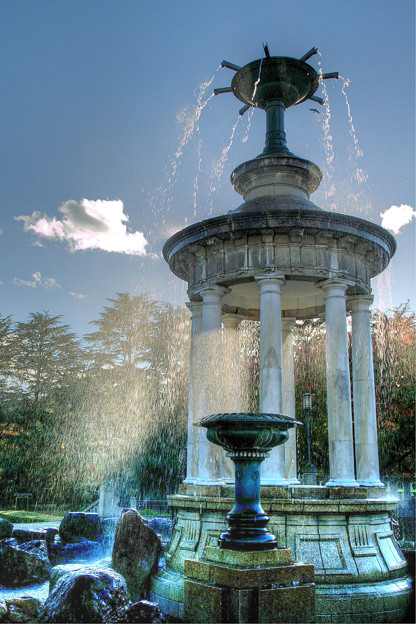
This Fountain Tower was built in time for the 10th Kansai Area Prefectural Union Joint Exhibition of 1910 at Tsuruma Park in Nagoya.

 It has a combination of Western and Eastern styles.  That is very remarkable when we see the Roman-style marble pillars for the tower and the Japanese-style rock structure in the ponds.

The tower is 10.2m high and the diameter of the top flat circular board is 2.5m.  The paving stones  were recycled from demolished street car railway track beds from downtown Nagoya.   The floor of the upper platform is covered with marble stones. What’s more, a type of famous Japanese ceramics called Bizen ware is used for decorative handrails or banisters.  Most of the stones in the ponds were from Kiso River, a prominent river for people in this region for centuries.

When we look at those eight narrow water spouts sticking out from the top flat circular board,
you will see the water from each spout hits the board below and trickles down into the ponds. That eventually generates splashes and mists of water.  It was, indeed, well designed and delighted the visitors. So it became a symbol of Tsuruma Park.

The designer was Mr. Teiji Suzuki, an engineer and professor, known as the "father of modern architecture in Nagoya."  He designed more than 40 buildings including private residences in and around the city of Nagoya.  Those buildings were pretty much modern with a beautiful balance of western and eastern tastes and drew people's attention.  Unfortunately, only 23 remain today  and the rest of the buildings were demolished or destroyed  mostly by bombing during the second world war.   It was just fortunate that the fountain tower was safe.


Interestingly, in 1973 the fountain tower at Tsuruma Park  was once removed from this spot due to a new subway construction. The new subway line was planned to run just under the fountain.
With 60 years passing by since its construction, the city was afraid that building the subway might cause damage to the old fountain tower.  4 years later it was restored again exactly as it was before.

The fountain tower was designated as a municipal cultural property in 1986 and will continue to be a symbol of the park.


(images are from the web)


Monday, October 03, 2016

How did it start?


Tsuruma Park was constructed in 1909 as the first public park in Nagoya.

It was in 1868 when the three-hundred-year-long samurai governance came to an end.
That was a drastic change for the whole society.
After opening the door to foreign countries, the new government was very much concerned about modernizing the country.  Industrialization was its primary purpose.

It is very interesting to note that Tsuruma Park was originally constructed as an industrial exhibition venue and not as a recreation ground for citizens. It was a good chance for Nagoya to take more steps forward to develop its local industries such as ceramics, lumber, and automotive looms and so on.

The exhibition was a well-known and distinctive project throughout the country and had been held every three years since 1884.   It was the city’s great honor to host this exhibition in Nagoya. The 31 prefectures participated and about 30 pavilions and buildings were constructed in the park, six times as big as the present Tokyo Dome Baseball Stadium.

During the three-month period, more than 2 million people visited the exhibition.
This number was very striking when the population of Nagoya was marked at 400,000 at that time.

Wednesday, September 28, 2016

An episode from history


水流間

Please take a look at these three Japanese kanji characters.
It used to be a name of a place.

It reads “tsu-ru-ma”, which means “a place full of water.”
These are the original characters for the place called "Tsuruma".

In fact, villagers of this area were often bothered by floods from a small, winding river.

However, in 1910, when the city of Nagoya decided to make their first public park at this place by reclaiming the site, they wanted to keep the original name but with different kanji to make a better impression on all the visitors to the new park, that is “鶴舞" (Tsuruma) park.

They use the kanji for "crane” and “dance”, but they still have the same reading.
In Japanese culture, a crane is a symbol of happiness and longevity and it sounds just perfect for the first public park in Nagoya.

Saturday, February 27, 2016

Radio Exercises in Tsuruma Park


Tsuruma Park in Nagoya was the first public park in the region. It was established in 1909.
The existing modern and classic buildings and monuments tell us many stories related to the origin of this park and life in Nagoya in the early 1900s.

The boy statue in front of us is one example.
He is frozen in the middle of doing calisthenics, called “rajio taiso”, which literally means “radio exercises”.


“Rajio taiso” has a long history of 88 years, from the first broadcast of exercise routines over the radio by the Japan Postal Insurance Bureau.
“Rajio taiso” is a kind of rhythmic exercise to music on the radio. The program starts at 6:30 in the morning every day and goes for 15 minutes.


The insurance bureau started this project so that people would be more conscious of maintaining good health since the Japanese life expectancy was quite low at that time. Strictly speaking the idea for radio broadcast calisthenics came from the US.  The exercise consists of 13 different but easy movements to stimulate almost all of your muscles -- even the inactive ones -- to get your blood circulating.

 
It was included as a regular group routine at elementary and junior high schools.
Later, in the 1950s, it was aired on TV as well as on the radio several times a day; it became very popular among adults at offices, factories and also at many other workplaces.
Currently, it is reported that 20% of the entire population, or around 27 million people, and 76% of elementary schools, still do radio exercises.

Regardless of age, almost all Japanese people can perform the 13 movements if they hear the music or sometimes simply by humming it. Here in Tsuruma Park, somewhere between 100 and over 350 people, usually seniors, gather around the Sougakudo bandstand for “rajio taiso” every morning throughout the year.Tsuruma Park is the perfect place for a “rajio taiso” gathering, and it has been this way for 50 years.

If you would like to join in doing “rajio taiso”, you don’t need to apply.
All you have to do is to get up early.

Sunday, September 20, 2015

Story of Tamateru-hime -----the way people cherish and enshrine a historical icon---


Tamateru-hime, who is enshrined in Senzo-in Temple, was extraordinarily beautiful and intelligent, but was treated miserably by her stepmother.

One rainy day, a young noble court man happened to see her put her own straw hat on a rain–soaked Buddhist statue in the street to protect it from the rain. He was very much impressed with her piety and finally married her.

Only once in every eight years, the original statue of Tamateru-hime is open to the public.
At the same time a huge amount of white cotton strings, called “Oteito” in Japanese, are connected together to make a long rope.

One end is tied around Tamateru-hime’s finger and it is run all the way across the temple precinct and the other end is finally attached to the front gate.
Visitors feel close to Tamateru-hime by touching the strings connected to her, and pray to lead a happy life just as Tamateru-hime did.

At the time this ritual started in Senzo-in Temple a long time ago, local people brought plain white cotton -- enough to make a kimono about 12 meters long -- to the temple.
They wrote their own names on the cotton and tied the pieces together one after another to make long ropes to run through the precinct.

After the ritual was over, the temple priest stamped the temple inscription to purify the cloth and gave it back to each family. They finally made this into a white kimono, namely as a burial vestments, to help one’s soul reach heaven safely.

Or pregnant women used this purified cloth simply to bundle their swollen bellies, wishing Tamateru-hime would protect young women and ensure they delivered their babies safely.

Regardless of the times, people have been longing for salvation and comfort not only from deities, but also from some outstanding, historical icons.

This is why Tamateru-hime and her Cinderella story have been cherished by many people especially young women over the centuries.


Note:
Senzo-in Temple stands in the south of Nagoya as one of the twelve sub temples to support Kasadera Temple. Kasadera Temple which belongs to the Shingon sect of Buddhism was the southernmost of the “Four Guardian Temples” surrounding Nagoya Castle. Kasadera Temple used to form a large temple town with its 12 disciple temples being stood side by side. It is said that Tamateru-hime and her husband made a great amount of donation to re-build Kasadera Temple.  It was renovated and well-maintained by the happy noble couple for the first time in 100 years since the temple was constructed in 736.