Showing posts with label Nagoya. Show all posts

Friday, July 05, 2024

Sake from the city of Yonago


I enjoyed some delicious sake at dinner with my family tonight. I found it in a pop-up stall in Matsuzakaya Department store this afternoon.

It's unpasteurized which means it's not heated or diluted. More importantly it is made of very rare sake rice called "Goriki", which is exclusively produced in the Tottori prefecture. Another ingredient is white koji mold.
Most people say that unpasteurized sake tastes fruity but the Goriki sake rice and the white koji mold give it a slightly sour, fresh taste. The aftertaste is also very pleasant.

My eyes were glued to the bulletin board on which every detail about the sake was hand-written. I read "Yonago" which is a city in the Tottori prefecture where my grandparents used to live. Sweet memories filled my heart. I enjoyed a chat with one of the staff from the Inata Brewery in Yonago.
The name of the brewery is Inata and this bottle of sake was named after "Princess Inata" who appears in the ancient legends about Shinto deities.


In Japan sake is produced in a number of places and generally speaking each brewery has established a long history and sense of pride. In each location differences in the spring water and rice used to make the sake and differences in climate make each sake very unique. Each one has its own history and taste.
It's really fascinating to find out about and explore these differences and see how they affect the taste.


Wednesday, February 14, 2024

Kabuki Day

I had a great time and really enjoyed my Kabuki day with my good friend Yuriko-san. What made it more fun for us was going to the theater in kimonos. Due to the pandemic, it had been quite some time since I last had the opportunity to savour the spectacular, dramatic, breathtaking and powerful experience of Kabuki theater. All in all, it was a perfect day.


Kabuki is an art that was proclaimed by UNESCO as an intangible heritage with an outstanding universal value. In today's diverse world, this traditional performance remains pre-dominantly male-dominated with a history spanning over 400 years, although it might be interesting to learn that it was first originated by a female dancer and her troupe. Kabuki went through some complicated changes during its early development before attaining its current social status as having one of the most accomplished traditional troupe of performers. Preserving their tradition and performance skills has been an ongoing and continous endeavour. Ultimately, this comes down to the expectations in the family and the goals set in the house of the male performers.


Yesterday I watched the performance in a Kabuki theater where one of the renowned families of Kabuki performers made a public appeal on stage. They announced that their 10-year-old son is now prepared to start his professional life as a Kabuki actor. It was so touching to see his innocent but perfect performance. I was deeply moved as I envisioned the long and challenging journey that lies ahead for him to become a respected kabuki actor of the next generation, inheriting his father's skills and reputation. 


Friday, December 04, 2020

One aspect of changing seasons in our daily life


I had an important tea gathering to attend last month. It was called "Kuchikiri no Chaji", which literally means "to unseal the pot of tea leaves."  It is an important tea procedure throughout the year to open it up for the first time,  take the tea leaves out of it, and grind the tea leaves to enjoy in the tea gathering.
 
Inside a pot, new leaves picked in early summer this year have been packed almost a half year for the best flavor. It was the first day to unseal this pot in our tea class.
 
We wore kimono to celebrate this occasion.
My teacher told us that this procedure was like celebrating the coming of the new year in the world of Japanese tea gatherings. I put on kimono that day with a sash full of embroidery depicting autumn harvest of fruits. I enjoyed our traditional kimono culture to appreciate the changes of the season, too. 
This gorgeous sash was from my late mother-in-law whose  mother had prepared for her marriage in 1930s. This is so precious and valuable in quality, too  I’m responsible for handing it over to my daughter.


Friday, August 14, 2020

Does COVIT-19 change our culture?


 We are in the midst of the Obon holidays in Japan. 

Obon is a series of Buddhist memorial services for family ancestors which generally takes place on August 14 and on 15. To put it more precisely, when the event takes place depends on the sect you belong to or the local area you live in. My family belongs to the Soto sect and the services of Obon actually start earlier in August.

Every year, this is the time when many Japanese visit family graves in temples together along with family members who usually live apart such as children with families of their own. It’s a big family reunion.

However, this year, due to the coronavirus pandemic, things are quite different.

In order to avoid close contact, our temple has decided to minimize Obon memorial services. They have also limited the number of visitors from one family. The other day, at the beginning of the Obon, two people from one family were allowed to attend the service with a mask on in accordance with the service time schedule. The temple main hall used to be full of families coming in and out the whole day, exchanging greetings with one another—but not this year. There was no opportunity for us to talk with the principle monk and his family in person, and no tea service to relax with after the prayers either. We just gave a simple bow in greeting and farewell from a distance.

On August 15th, the last day of the Obon, the memorial service for our ancestors won't be an exception. This time, four members from one family will be allowed to participate in the memorial service in the main hall.
Surprisingly enough, many other temples have also suspended the Obon memorial services in their halls and have decided to provide memorial services via the Zoom meeting instead. We had never expected that IT technology would prevail in our traditional practices at temples and at home.

I know the temples took a drastic measure to prevent us from infection. Yet, it's sad that we are forced to change our tradition. No one can tell what Obon will look like next year.

No matter what, it’s time for us to remember our ancestors, including our parents who left us not so long ago, and to pray to them for protection at our family altar.


Tuesday, June 16, 2020

The Amabie is Back

 In Japanese folklore, we have many imaginary supernatural creatures called “youkai”, whose history mostly dates back to the period between the 17th and the 19th centuries.


The “amabie” is one example. It has recently caught our attention throughout the country. The creature has a mermaid-like body but its face looks like a bird with a beak, and it wears its hair very long. It is believed to be a harbinger of disease, telling people, "Draw my image and pass it on to others so as to ward off infectious disease." That's the reason the amabie has come back into our modern lives during the coronavirus pandemic.

People have been posting many amabie drawings on SNS, and they have gone viral. What's more, Japanese sweet shops across the country have been making sweets in shape of the creature.

Let's not talk about whether you approve of this business trend of making a profit from coronavirus confusion. We surely take comfort in sharing amabie products in hopes that we can put an end to the crisis.


Wednesday, May 27, 2020

A concern following the lifitng of the state of emergency


This is the familiar view of the station building I saw this morning.
It was good to see nothing had changed. That being said, I feel that something has changed inside of me. I'm looking at the scenery with different eyes. I saw people wearing masks, few cars pulling in to the station, and few people waiting on the Shinkansen platform.

The state of emergency was lifted on Monday. Schools, businesses and many other social activities are gradually starting again with new social norms, such as washing your hands, wearing masks, and maintaining physical distance with others. Social life now definitely seems different from the one we cherished.

I hope we can manage this new stage in our lives without any serious cases rebounding.

Monday, April 16, 2018

Charms of visiting Nagoya

 The city of Nagoya, the capital of Aichi Prefecture, is located just between Tokyo and Osaka. Nagoya has a history as a homeland of "samurai" warriors who had fought to unify the country in the 16th and 17th centuries. In fact the first political leader in history, called a "shogun, " came from this region. Nagoya Castle and Main Palace are part of our influential heritage and show the achievement of outstanding samurai in those days.


Present Nagoya is the fourth largest city in Japan and the leading city of the manufacturing industries across the nation especially in the automobile, aviation and iron & steel industries. Over the years, this success is still greatly owed to the samurai rulers. These rulers encouraged skilled craftsmen to move to this region to promote the local industry while the central samurai government had failed to protect them due to strict economy policies.


Nagoya is a hub. Nowadays, many tourists from abroad see the advantages of visiting Nagoya. We have Chubu International Airport which is a 40-minute train ride to and from the center of Nagoya. The Shinkansen Bullet train from Nagoya station connects the city to many destinations nationwide. Furthermore, accommodation is more reasonable in regards to price compared to any other big tourist cities like Kyoto, Tokyo and Osaka. Please make the best use of your JR Pass to go back and forth. While you are in town, you will surely feel at home, too. It's easy to get around with public transportation such as the subway, buses, and private train lines.

For tourists visiting Nagoya for the first time, Nagoya Castle including Main Palace should be top of the list. You may also like to visit the popular temple in downtown Nagoya and also one of the three main great shrines in Japan. Aside from these, you may like to visit Toyota Museum of Industry and Technology, Tokugawa Art Museum or one or two Japanese gardens. Depending on how long you will be in Nagoya, I will customize the best tour for you accordingly so you can really get the most out of your stay.

Let's explore Nagoya! I hope you find the city charming!

Saturday, April 07, 2018

The theater is back


The new Misonoza Theater in the city of Nagoya opened after five years of rebuilding. A kabuki play put on by one of the prestigious families of actors is now being performed every day to celebrate the grand opening of the theater. April 25 is the last show.

I love kabuki.

For one thing, I am fascinated by the gorgeous stage, which follows tradition, and also by how it is performed, which has been passed on for generations. And for another, my friend plays a leading gidayu; in other words, a narrator who chants stories with his powerful and emotional voice.

Watching kabuki gives me a chance to leave my routine life behind and get lost in a unique and magical world.

Thursday, February 08, 2018

Retired Hina Dolls

For the last few years, you may have seen some small hina dolls in unexpected places or in unusual postures.

At the Chubu International Airport, I saw hina dolls sitting casually along a sidewalk into a building. They didn't sit neatly on a tiered stage, just like you would expect with a regular set of hina dolls on display. 

Rather, they were placed in many spaces and on corners, and they were in some vivid, realistic poses. Some are reading newspapers or books, and some talking over a cup of coffee together; some hoist a flag of welcome to tourists, and some look happy with shopping bags in their arms.

They are happily "retired hina dolls".

When their outfits got worn out over the years and were not suitable to be displayed at home, people handed them down to various public communities in towns and cities across the country. People arranged those dolls to entertain visitors, so as to energize communities during the hina doll festive season.

So they are called “fuku-yose-bina” in Japanese, which literally means “good luck inviting hina dolls.”


Tuesday, July 18, 2017

A view from Yuhintei Arbor


As it is generally true for many Japanese gardens, Shirotori garden also depicts the landscape of the central Japan, which is so crucial in talking about the history of this region.

The big fir tree and the stand of trees in the far distance represents the Kiso mountains in Gifu prefecture, which produces good quality of Japanese cedar lumber.
Pine trees along the river banks in the middle distance portray a fertile riverside district of rice paddies called the Suigo area in Aichi prefecuture.

With the woody hills in the far distance and the pine trees in the middle, the view from Yuhin-tei Arbor becomes much alive and dynamic as it is in real life.

Watching the colorful koi (carp) fish swimming and approaching gracefully is a special treat and is very relaxing.

Visitors are always fascinated by the grand view from here in every season, such as the cherry blossoms on weeping branches in spring, the hydrangea flowers in early summer, the autumn foliage and the pine trees tied with rope in winter.


Tuesday, July 11, 2017

The main gate to Shirotori Garden


Take a look at the entrance gate to Shirotori garden.
An interesting point to notice is the curve of the roof just above the entrance.
It is traditional Japanese carpentry work called 「唐破風」(karahafu).

Since elegant shapes were very much favored by feudal lords, it added more value to the building when this style was used.

There is another factor why it was often used at the entrance of traditional buildings such as castles, temples, shrines and palaces.

On rainy days, a curved line lets falling rain run to both ends of the curve, which prevents guests from getting wet from water running of the roof edge above the entrance.
So, the designer of the garden used this style for the benefit of visitors on rainy days.

Saturday, July 08, 2017

The way we name this little plant


 These flowers are called "lizard's tail" in English. Isn't it a "lovely" name? 
It was named so since the drooping flower depicts a lizard's tail, they say.


On the other hand, 半化粧 (はんげしょう)is a Japanese name for these white, slender and drooping flowers. The most beautiful part of this plant is that some leaves have white splashes on the surface as if a woman were putting powder on her face to meet her loved one. That is why we call it "han-ge-shou", which literally means " putting makeup on halfway" in Japanese.
So romantic, isn't it? They delighted my eyes this afternoon at Shirotori Japanese Garden.

Sunday, July 02, 2017

Kabuki at a temporary theater in the Nagoya Castle grounds


The Heisei Nakamura-za, the most renowned troupe of kabuki performers, came back to the Nagoya Castle grounds for the first time in 8 years!
Tickets were quickly sold out.

That just goes to show how people have been waiting for their next performance at a temporary theater, especially after the troupe had lost their main actor to cancer. His name was Kanzaburo Nakamura XVIII, and he was just 58 years old at his death. He put his all his energy into revitalizing the traditional atmosphere which a temporary theater brings to an audience; just the way kabuki used to be.

Unlike many modern kabuki theaters with advanced technologies, this type of theater is a temporary one, and after a run, it will be taken away. This was common in the olden days when a troupe visited rural towns and villages for a performance.


In general, a temporary theater is small but it has an advantage! You find yourself much closer to the stage. Your eyes meet your favorite actor's eyes when he stops on stage for an exaggerated, dramatic pose. It is very particular in kabuki performance.

Kabuki has a very unique style of stage performance, and has a long history of more than 400 years. Historical stories based on the era of the samurai warriors were performed by men-only troupes (they take the women's roles as well). The actors grow up and are trained in notable families of kabuki performers, as it has always been over the generations.

Dynamic stage settings and colorful, traditional costumes are eye-catching. The style of performance is elaborate and bold with lots of motion and sound. Kabuki actors, with their strong attachment toward Japanese traditional arts, have been entertaining people for centuries.


Now the Heisei Nakamura-za troupe is back again with Kanzaburo's two adult sons following in their father's footsteps. That day, in the temporary theater in the Nagoya castle grounds, the whole audience gave a big round of applause for the passionate kabuki performance.


Tuesday, March 14, 2017


An Upcoming Exhibition

You may have noticed that many English language versions of official website in Japan do not give readers much information. You may find that English pages hardly get updated. It's a shame.
So I am going to tell you about an interesting exhibition at a railway museum in Nagoya.


It's coming soon. It's a special exhibition on the history of shinkansen electrics and track inspection trains, aka "Doctor Yellow", at SCMAGLEV and Railway Park in Nagoya. "Doctor Yellow" is the nickname for an inspection train for bulletin train tracks. Since it does not carry passengers and doesn't run on a regular schedule, it always draws the attention of many railway fans, both young and old. The result is the superstition that it is good luck for people who catch a sight of it in operation.

The special exhibition "History of Doctor Yellow" will be from March 15 to September 25. Open 10:00 to 17:30. Closed on Tuesday. For more general information about the museum, check their English site. http://museum.jr-central.co.jp/en/

Friday, October 14, 2016

Landmark of the park


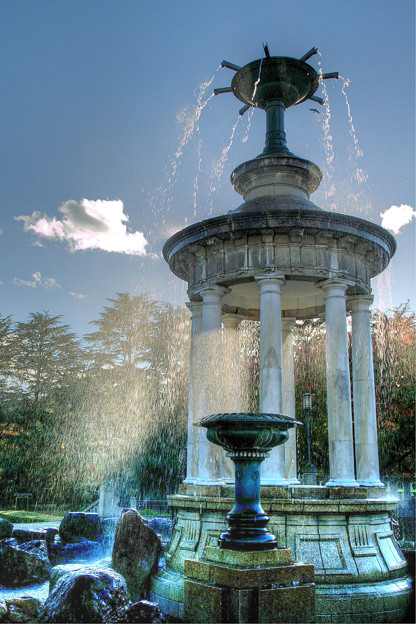
This Fountain Tower was built in time for the 10th Kansai Area Prefectural Union Joint Exhibition of 1910 at Tsuruma Park in Nagoya.

 It has a combination of Western and Eastern styles.  That is very remarkable when we see the Roman-style marble pillars for the tower and the Japanese-style rock structure in the ponds.

The tower is 10.2m high and the diameter of the top flat circular board is 2.5m.  The paving stones  were recycled from demolished street car railway track beds from downtown Nagoya.   The floor of the upper platform is covered with marble stones. What’s more, a type of famous Japanese ceramics called Bizen ware is used for decorative handrails or banisters.  Most of the stones in the ponds were from Kiso River, a prominent river for people in this region for centuries.

When we look at those eight narrow water spouts sticking out from the top flat circular board,
you will see the water from each spout hits the board below and trickles down into the ponds. That eventually generates splashes and mists of water.  It was, indeed, well designed and delighted the visitors. So it became a symbol of Tsuruma Park.

The designer was Mr. Teiji Suzuki, an engineer and professor, known as the "father of modern architecture in Nagoya."  He designed more than 40 buildings including private residences in and around the city of Nagoya.  Those buildings were pretty much modern with a beautiful balance of western and eastern tastes and drew people's attention.  Unfortunately, only 23 remain today  and the rest of the buildings were demolished or destroyed  mostly by bombing during the second world war.   It was just fortunate that the fountain tower was safe.


Interestingly, in 1973 the fountain tower at Tsuruma Park  was once removed from this spot due to a new subway construction. The new subway line was planned to run just under the fountain.
With 60 years passing by since its construction, the city was afraid that building the subway might cause damage to the old fountain tower.  4 years later it was restored again exactly as it was before.

The fountain tower was designated as a municipal cultural property in 1986 and will continue to be a symbol of the park.


(images are from the web)


Monday, October 03, 2016

How did it start?


Tsuruma Park was constructed in 1909 as the first public park in Nagoya.

It was in 1868 when the three-hundred-year-long samurai governance came to an end.
That was a drastic change for the whole society.
After opening the door to foreign countries, the new government was very much concerned about modernizing the country.  Industrialization was its primary purpose.

It is very interesting to note that Tsuruma Park was originally constructed as an industrial exhibition venue and not as a recreation ground for citizens. It was a good chance for Nagoya to take more steps forward to develop its local industries such as ceramics, lumber, and automotive looms and so on.

The exhibition was a well-known and distinctive project throughout the country and had been held every three years since 1884.   It was the city’s great honor to host this exhibition in Nagoya. The 31 prefectures participated and about 30 pavilions and buildings were constructed in the park, six times as big as the present Tokyo Dome Baseball Stadium.

During the three-month period, more than 2 million people visited the exhibition.
This number was very striking when the population of Nagoya was marked at 400,000 at that time.

Wednesday, September 28, 2016

An episode from history


水流間

Please take a look at these three Japanese kanji characters.
It used to be a name of a place.

It reads “tsu-ru-ma”, which means “a place full of water.”
These are the original characters for the place called "Tsuruma".

In fact, villagers of this area were often bothered by floods from a small, winding river.

However, in 1910, when the city of Nagoya decided to make their first public park at this place by reclaiming the site, they wanted to keep the original name but with different kanji to make a better impression on all the visitors to the new park, that is “鶴舞" (Tsuruma) park.

They use the kanji for "crane” and “dance”, but they still have the same reading.
In Japanese culture, a crane is a symbol of happiness and longevity and it sounds just perfect for the first public park in Nagoya.

Saturday, February 27, 2016

Radio Exercises in Tsuruma Park


Tsuruma Park in Nagoya was the first public park in the region. It was established in 1909.
The existing modern and classic buildings and monuments tell us many stories related to the origin of this park and life in Nagoya in the early 1900s.

The boy statue in front of us is one example.
He is frozen in the middle of doing calisthenics, called “rajio taiso”, which literally means “radio exercises”.


“Rajio taiso” has a long history of 88 years, from the first broadcast of exercise routines over the radio by the Japan Postal Insurance Bureau.
“Rajio taiso” is a kind of rhythmic exercise to music on the radio. The program starts at 6:30 in the morning every day and goes for 15 minutes.


The insurance bureau started this project so that people would be more conscious of maintaining good health since the Japanese life expectancy was quite low at that time. Strictly speaking the idea for radio broadcast calisthenics came from the US.  The exercise consists of 13 different but easy movements to stimulate almost all of your muscles -- even the inactive ones -- to get your blood circulating.

 
It was included as a regular group routine at elementary and junior high schools.
Later, in the 1950s, it was aired on TV as well as on the radio several times a day; it became very popular among adults at offices, factories and also at many other workplaces.
Currently, it is reported that 20% of the entire population, or around 27 million people, and 76% of elementary schools, still do radio exercises.

Regardless of age, almost all Japanese people can perform the 13 movements if they hear the music or sometimes simply by humming it. Here in Tsuruma Park, somewhere between 100 and over 350 people, usually seniors, gather around the Sougakudo bandstand for “rajio taiso” every morning throughout the year.Tsuruma Park is the perfect place for a “rajio taiso” gathering, and it has been this way for 50 years.

If you would like to join in doing “rajio taiso”, you don’t need to apply.
All you have to do is to get up early.

Tuesday, December 01, 2015

Shioiri no Niwa (Garden with a tidal pond)

Let me introduce you to a unique type of Japanese garden in Shirotori.
We call it Shioiri Garden. “Shioiri” means “incoming tide" in English.
As you imagine from the word, “incoming tide,” the water in this pond depicts the incoming and outgoing ocean flows of Ise Bay.


The main concept of the garden is to portray the tides.
Ise Bay has been so prominent for people living in this region.

Please take a look at the wall in the background with white and grey checkered patterns.
It depicts some mountains in this central region such as Mt. Ontake or the Kiso Mountains.
With that being said, you can see how Shioiri Garden incorporates yet another expression of nature from our region.

It looks very modern though.
Modern technology has made this garden so unique, that it won the Urban Landscape prize from the city of Nagoya 24 years ago.


There are three points I’d like to introduce you to so that you will be able to enjoy the garden.

First, the water is controlled by a pump to reproduce the movement of Ise Bay's ocean tide.
If you stay here, you will be able to see the tide slowly coming in and out every 30 minutes.

Second, a winding titanium pipe hovering on the surface of the water, is eye catching.
This modern sculpture expresses the waves reaching shore after hitting rough rocks.

Lastly, there you can see some fountain spouts along the pipes.
They emit water to fill the pond like that of a tide gradually coming in, which is mesmerizing to watch.


Aside from these three elements, the garden designer also arranged a pair of rocks, one large and one small, in the pond to give you the image of the pair of sacred rocks at the shore near  Ise Grand Shrine in Mie Prefecture.

For some people, they are reluctant to call Shioiri Garden a Japanese garden.

However, considering Japanese strolling gardens were very much appreciated by daimyo; I’m sure they would have enjoyed a unique spot in which they could entertain their important guests.

I personally love the challenging idea of Shioiri Garden.
It is definitely a Japanese garden of this century.


Sunday, September 20, 2015

Story of Tamateru-hime -----the way people cherish and enshrine a historical icon---


Tamateru-hime, who is enshrined in Senzo-in Temple, was extraordinarily beautiful and intelligent, but was treated miserably by her stepmother.

One rainy day, a young noble court man happened to see her put her own straw hat on a rain–soaked Buddhist statue in the street to protect it from the rain. He was very much impressed with her piety and finally married her.

Only once in every eight years, the original statue of Tamateru-hime is open to the public.
At the same time a huge amount of white cotton strings, called “Oteito” in Japanese, are connected together to make a long rope.

One end is tied around Tamateru-hime’s finger and it is run all the way across the temple precinct and the other end is finally attached to the front gate.
Visitors feel close to Tamateru-hime by touching the strings connected to her, and pray to lead a happy life just as Tamateru-hime did.

At the time this ritual started in Senzo-in Temple a long time ago, local people brought plain white cotton -- enough to make a kimono about 12 meters long -- to the temple.
They wrote their own names on the cotton and tied the pieces together one after another to make long ropes to run through the precinct.

After the ritual was over, the temple priest stamped the temple inscription to purify the cloth and gave it back to each family. They finally made this into a white kimono, namely as a burial vestments, to help one’s soul reach heaven safely.

Or pregnant women used this purified cloth simply to bundle their swollen bellies, wishing Tamateru-hime would protect young women and ensure they delivered their babies safely.

Regardless of the times, people have been longing for salvation and comfort not only from deities, but also from some outstanding, historical icons.

This is why Tamateru-hime and her Cinderella story have been cherished by many people especially young women over the centuries.


Note:
Senzo-in Temple stands in the south of Nagoya as one of the twelve sub temples to support Kasadera Temple. Kasadera Temple which belongs to the Shingon sect of Buddhism was the southernmost of the “Four Guardian Temples” surrounding Nagoya Castle. Kasadera Temple used to form a large temple town with its 12 disciple temples being stood side by side. It is said that Tamateru-hime and her husband made a great amount of donation to re-build Kasadera Temple.  It was renovated and well-maintained by the happy noble couple for the first time in 100 years since the temple was constructed in 736.